Chapter 15 — Geopolitics and the safe-haven bid
Gold has a reputation as the asset you own when the world is on fire. This reputation is partially deserved and partially misleading, and the distinction matters because it determines how long you should hold a position you took on a geopolitical headline.
The reputation is partially deserved because gold does respond, immediately and reliably, to acute geopolitical shocks. War. Terrorism. Coup attempts. Sovereign defaults. Sanctions surprises. Within an hour of any of these, gold is up.
The reputation is misleading because the initial response to a geopolitical shock is almost always followed by a fade. The premium decays as the market re-prices the actual economic impact. Most geopolitical shocks turn out to be smaller in their economic effect than the initial reaction implied. The result: traders who buy gold on a geopolitical headline and hold for weeks usually give back the gains.
This chapter is about the safe-haven bid — when to take it, when to hold it, and when to know that the move has more legs than the headlines suggest.
The half-life of geopolitical premium
Most acute geopolitical events follow a similar pattern in gold:
- Hour 0-4: Sharp move higher. Algorithmic and discretionary buying as headlines hit. Typical magnitude: 1-3% spike.
- Day 1-3: Sustained elevation as the news cycle keeps the event in focus. Additional 0.5-1.5% can be added if the situation escalates.
- Day 4-10: Fade. Half of the initial premium typically gives back as the market reassesses the economic impact. The original news is no longer fresh, the algorithmic positioning has unwound.
- Day 10-30: Most events have fully decayed back to pre-event levels, unless they have produced sustained second-order effects (sanctions, supply disruption, currency moves).
- Beyond 30 days: The gold move is now driven by the underlying macro consequences (oil prices, fiscal response, central bank decisions), not by the original headline.
This pattern is the empirical norm. It does not apply to every event — some are large enough that they produce sustained second-order effects, which we will get to — but it applies to most.
The implication for a trader: a pure geopolitical trade should be a short-horizon trade. Five to ten days, sized accordingly. Not a position you hold for months expecting the headline to keep paying.
When the premium sticks
Some geopolitical events produce gold rallies that don't fade. The ones that have, historically:
- The Soviet invasion of Afghanistan, December 1979. Gold from $510 to $850 over the following 6 weeks. The premium stuck because it coincided with the Iranian revolution and oil shock, producing real second-order inflation effects.
- 9/11, September 2001. Gold rose from $271 to $290 over 10 days, then mostly faded. But the longer-term effect — US military spending, Fed easing, dollar weakness, eventual Iraq War — produced a 10-year bull market in gold. The post-9/11 bull was not the immediate safe-haven trade; it was the macro response trade that followed.
- The 2008 financial crisis. Initial gold response was actually negative (liquidity selling, Chapter 16). The bull market that followed was driven by Fed QE and zero interest rates, not by the original Lehman headline.
- The 2022 Russian invasion of Ukraine. Gold rose from $1,910 to $2,070 in 7 days. Faded to $1,830 by July. But this event triggered the central bank reserve buying regime change (Chapter 10), which produced the multi-year bull market that followed. The headline trade faded; the structural trade ran for years.
The pattern: geopolitical events that produce structural changes in macro variables (oil supply, central bank behavior, dollar dominance, Fed reaction function) produce lasting gold rallies. Geopolitical events that are episodic — terrorist attacks, isolated military strikes, diplomatic crises that resolve — produce 5-10 day spikes that fade.
A trader's job on day one of a geopolitical event is to assess: will this produce a structural change? If yes, the short-term spike is the start of a much longer move. If no, the short-term spike is the trade itself, and you exit when the news cycle moves.
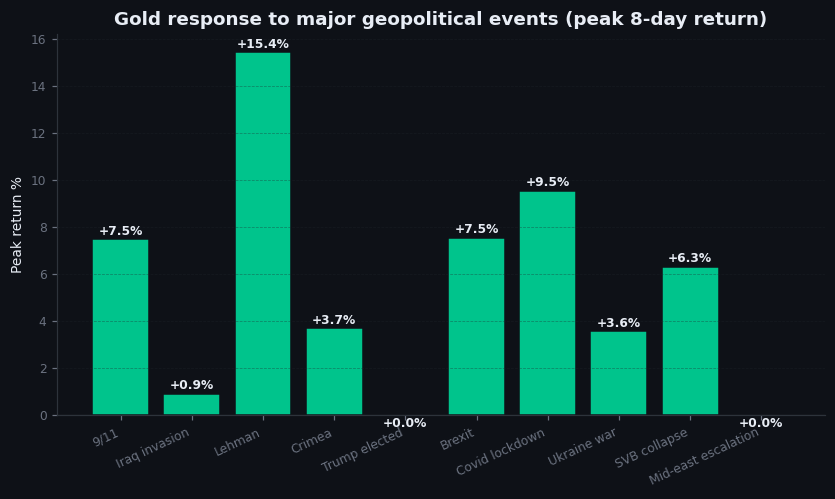
Figure 15.1 — Gold response to major geopolitical events, 2001–2026
Series of small annotated charts, one per event. Each shows gold price for 60 days around the event date, with the event marked at day 0. Events included: 9/11 (2001), Iraq War start (2003), Russia-Georgia (2008), Crimea (2014), Brexit (2016), trade war escalation (2018-2019), COVID lockdowns (2020), Ukraine invasion (2022), Israel-Gaza (2023), [recent 2025-2026 event]. Side-by-side visual showing which events produced lasting effects (Ukraine 2022, COVID 2020) vs which faded (most of the others).
The 2022 reset
The Ukraine invasion of February 2022 is the most important geopolitical event for gold in the past 50 years, and it requires its own treatment.
The immediate response was textbook: gold rose from $1,910 to $2,070 over the first week, then faded back to $1,830 over the following four months. By July 2022, the "Ukraine premium" had completely decayed. A trader who had taken the safe-haven trade in late February and held for five months had given back most of the gains.
But the event had produced a structural change that nobody priced correctly at the time: the freezing of Russian central bank dollar reserves established that dollar reserves could be unilaterally confiscated for political reasons. This was a multi-decade reset of how non-aligned central banks managed their reserves. The structural buying that began in 2022 and continues today is the second-order consequence of that single decision.
The trader who recognized the structural reset in real time was buying gold after the February-July headline fade, at $1,650-$1,800, with a multi-year thesis on central bank reserve diversification. That trade ran from late 2022 to today — a 180% return that has nothing to do with the original "safe-haven response to Russian invasion" trade.
The lesson: the immediate response to a geopolitical event is rarely the right trade. The structural change the event produces is sometimes the right trade. Recognizing the difference is the most valuable geopolitical analysis you can do.
A specific decay function for retail use
For practical trading purposes, here is a rule of thumb for geopolitical events:
- If the event is contained (a battle, an attack, a single act): 5-10 day trade, exit when news cycle moves. Sized small (1% of capital max), pure sentiment-layer trade per Chapter 5.
- If the event causes a measurable supply disruption (oil, food, semiconductors): 30-90 day trade, exit when prices normalize or when the disruption resolves. Sized moderate.
- If the event causes a regime shift (sanctions framework, central bank behavior, currency reserve management, Fed reaction function): multi-year trade. The size and time horizon are macro-layer, not sentiment-layer. Re-thesis explicitly.
Most events are category one. Some are category two. Very few — maybe one every five to ten years — are category three. The trader who treats every geopolitical event as category three holds too long and gives back gains. The trader who treats every event as category one misses the rare regime-shift trades. Discipline is in the assessment.
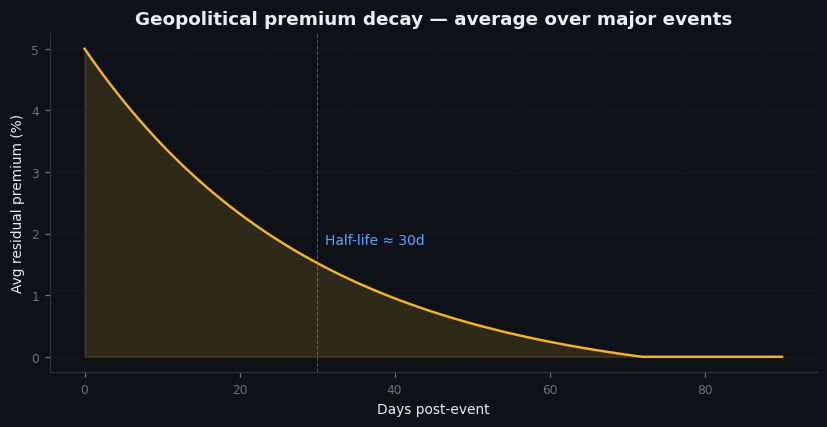
Figure 15.2 — Geopolitical premium decay function, average across events
Line chart showing average gold price as a percentage of pre-event price, days -10 to +60 from event date, averaged across the major geopolitical events of the past 25 years. Visible decay curve: rapid rise to peak around day 3-5, gradual decay back toward 100% over 30-45 days. Side-by-side comparison: average of "episodic" events (decays cleanly back to 100%) vs average of "regime change" events (stays above 100% with continued drift higher).
Illustrative — schematic average decay function.
On goldintel today
The dashboard's news feed and session briefs both pick up geopolitical headlines and assign direction labels. The scoring is generally good at distinguishing acute headlines from regime-change implications — but not perfect, and especially not perfect at the moment of an event.
The discipline is to read the dashboard's labeling, but to do your own assessment on category. A headline tagged "high impact bullish gold" might be a 7-day trade or a 7-year trade. The dashboard cannot, at this stage, reliably tell you which. That assessment is yours.
Common mistakes
- "Hold the geopolitical trade because the situation is still ongoing." Most situations are "still ongoing" for months without producing gold moves. The market prices in expected outcomes within days. Stale headlines stop moving price.
- "Sell the rally as soon as the spike is in." Sometimes correct, sometimes catastrophic. If the event is regime-shifting, the early spike is the beginning, not the end. Better to hold partial size and assess over days.
- "Geopolitical premium is irrational." It is mostly rational — markets are pricing legitimate expected economic effects. The irrationality is in over-extending the premium, which is what produces the fade.
- "The next big event will look like the last one." It will not. Each event has its own shape. The 1979 Soviet Afghanistan and the 2022 Russia Ukraine both produced 25-year arcs, but for completely different reasons. Pattern-matching on event types is a weak heuristic.
Key takeaway
Geopolitical events produce short-term safe-haven spikes that mostly fade in 5-30 days. The exception — events that produce structural change in macro variables — produce multi-year trends. The job is to assess which kind of event you're trading, and to size accordingly.
Further reading:
- Niall Ferguson, The Square and the Tower — for the structural-vs-episodic distinction in geopolitical events.
- Council on Foreign Relations, Geopolitical Risk Tracker (free, useful for daily situational awareness).
- BIS Quarterly Review, dedollarization and reserve composition sections (especially editions from 2022-2024).
- For the 2022 Russia reset specifically: Adam Tooze, Chartbook substack — running commentary with serious depth.
Quick reference
| Event type | Typical premium | Half-life | Tradability |
|---|---|---|---|
| Major war / invasion | +5–10% | 2–6 months | Long initially, fade rallies |
| Sanctions / reserve seizure | +3–8% | Permanent shift | Structural, hold |
| Terror attack | +1–3% | Days to weeks | Fade quickly |
| Election shock | +1–5% | Weeks | Direction depends on outcome |
| Regional conflict (limited) | +0.5–2% | Days | Often a fade |