Chapter 5 — What you're betting on when you trade gold
A trader I know — a friend, with twenty years in macro — was long gold from $2,400 in early 2024. He held the position through the rally to $2,800 and the consolidation that followed. In late 2024, when gold dipped to $2,580, he doubled his size. The rally resumed. By January 2025 he was up nearly 50% on the position and starting to talk about taking some off.
I asked him what his exit signal was.
He thought about it for a moment and said, "When the dollar bottoms."
This is a perfectly reasonable answer. But it was also the wrong one — because the thing he had bought was not a bet on the dollar. He had bought gold in early 2024 on the back of central bank buying. His original thesis was reserve diversification post-Russia-sanctions. The trade had worked beautifully on that thesis. But somewhere along the way, in his head, the thesis had drifted into a generic "macro long gold" trade that he was now planning to exit on a generic dollar signal.
He exited in April 2025 on a brief DXY bounce. Gold continued to $3,200 over the next three months. He had been right about the trade and wrong about the exit, because he had stopped knowing what he was actually betting on.
This chapter is about that mistake. It is one of the most common errors in gold trading, and it costs traders billions of dollars a year in missed continuations and premature exits.
The three layers of any gold trade
Every gold trade — every trade in any asset, really — is one of three things, and usually you should know which one before you click buy. The three layers are:
1. The macro layer. A bet on a slow-moving macro variable — real yields, dollar strength, inflation regime, central bank policy. These trades unfold over weeks to months. Exit signal: when the macro variable reverses.
2. The sentiment layer. A bet on a sentiment shift — risk-off, safe-haven flows, panic into gold. These trades unfold over days to weeks. Exit signal: when sentiment normalizes.
3. The microstructure layer. A bet on positioning, flows, or technical structure — overcrowded short squeeze, breakout from a multi-week base, options gamma effects. These trades unfold over hours to days. Exit signal: when the structural setup resolves.
Most retail trades blend these without knowing it. The trader sees gold breaking out (microstructure), reads a headline about Fed cutting rates (macro), feels the risk-off vibe (sentiment), and clicks buy with a vague conviction that something is happening. The trade either works or doesn't, and the trader updates their mental model based on the outcome — not on the mechanism.
The discipline this chapter is teaching is: before you buy, write down which layer you are buying on. One sentence. "I am long gold because real yields are about to fall (macro)." Or, "I am long gold because positioning is over-short and a squeeze is due (microstructure)." Or, "I am long gold because the geopolitical headline is real and the safe-haven bid is going to extend for at least three sessions (sentiment)."
That one sentence determines everything else about the trade: the time horizon, the size, the stop, the take-profit, and most importantly the exit signal. A macro trade exits on a macro reversal. A microstructure trade exits when the squeeze finishes. A sentiment trade exits when the news cycle moves on. Confusing one for another is how my friend exited a macro trade on a sentiment signal and left $400 on the table.
Worked example — three different reasons to be long, same week
In September 2024, three different traders went long gold around $2,650. All three were long the same instrument. All three made money. But each was making a different bet, and the right time to exit was different for each.
Trader A — macro long. Thesis: PBoC reserve buying is resuming after a six-month pause; structural EM central bank demand is reasserting; real yields are likely to ease into year-end as the Fed signals cuts. Time horizon: 3-6 months. Sized at 4% of capital. Stop: 8% below entry. Exit signal: PBoC pauses again, or US 10-year yields break above 4.6% on a closing basis. Trader A held through October and November, took 60% off at $2,850 in early December, held the rest through the consolidation, and exited the final tranche at $3,150 in March 2025 when the PBoC's monthly reserve update was flat. Total return on the position: roughly +18%.
Trader B — sentiment long. Thesis: the late-September Middle East escalation will drive at least a week of safe-haven flows. Time horizon: 5-10 trading days. Sized at 1% of capital (small because it's a short-horizon trade). Stop: 2% below entry. Exit signal: VIX comes back below 18 or the news cycle moves to a different topic. Trader B captured most of the safe-haven spike, exited at $2,790 nine days later when the headlines moved to US election coverage. Total return: roughly +5% on the position, or +0.05% on capital. Annualized at that frequency, profitable.
Trader C — microstructure long. Thesis: CFTC speculative positioning has reset to near-zero net long; ETF flows have stabilized; the daily chart shows a clean breakout from a four-week base at $2,610. Time horizon: 1-3 weeks. Sized at 2% of capital. Stop: just below the breakout level at $2,605. Exit signal: positioning rebuilds to multi-month highs, or price breaks back below the base. Trader C captured the immediate breakout move, took 50% off at $2,720 within a week, and exited the rest at $2,770 ten days later when daily momentum stalled. Total return: roughly +4%.
All three traders made money. None of them confused the others' setups for their own. Trader B was not tempted to hold for three months because he knew he was on a sentiment trade. Trader C did not panic and double down when his microstructure trade stalled, because he knew his time horizon was a week. Trader A did not exit on the brief October dip because his thesis had not been invalidated.
The discipline is in the labeling, not the analysis.
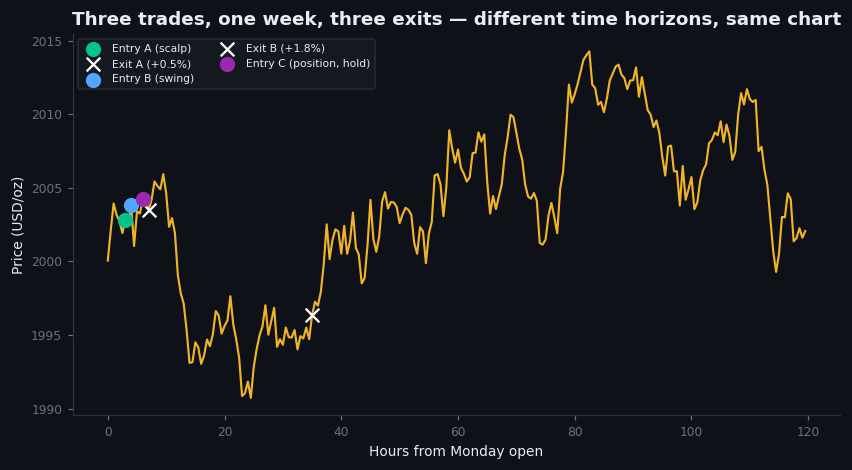
Figure 5.1 — Three trades, one week, three exits
Annotated chart of XAUUSD daily candles from September 1 to December 31, 2024. Three colored entry arrows at approximately the same price level around $2,650 (mid-September). Three colored exit markers at different points: green (Trader C) at $2,770 in late September; orange (Trader B) at $2,790 in early October; blue (Trader A, first tranche at $2,850 in early December, second tranche at $3,150 in March). Caption emphasizing that the same entry produced three correct exit strategies based on three different theses.
Illustrative — illustrative — three hypothetical trades on a synthetic chart.
How to know which layer you are on
A practical test, asked before every trade:
- If the next FOMC decision goes 50bp differently than expected, does this trade change? Yes → macro layer.
- If today's geopolitical headline gets walked back tomorrow, does this trade change? Yes → sentiment layer.
- If positioning shifts but no macro or sentiment news, does this trade change? Yes → microstructure layer.
If the answer is "yes" to all three, you don't have a thesis — you have a vibe. Vibes can work, but they have no exit signal, so they tend to be exited on emotion rather than on logic. Most blow-ups in gold trading start as vibe trades that the trader doesn't realize are vibes.
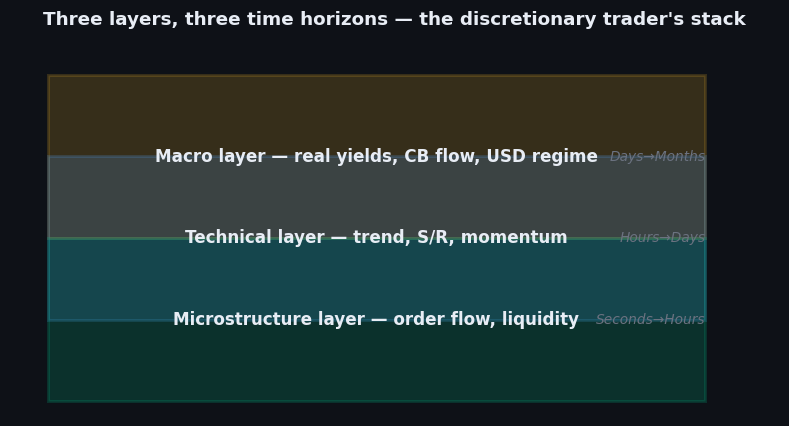
Figure 5.2 — Three layers, three time horizons
Diagram. Three nested rectangles labeled (from outer to inner): Macro layer (3-6 months, slow-moving variables), Sentiment layer (5-15 days, news cycle), Microstructure layer (1-10 days, positioning and flows). Each layer labeled with example variables (real yields, central bank flows, DXY for macro; geopolitics, risk-off, headlines for sentiment; CFTC positioning, ETF flows, technical structure for microstructure) and example exit signals.
Illustrative — schematic — concept diagram.
On goldintel today
The dashboard maps reasonably well onto the three layers, though it does not surface them by name:
- Macro layer: Market Drivers panel (DXY, US10Y, CPI, VIX), News Feed with macro-tagged headlines, Strategy panel's macro factor.
- Sentiment layer: News Feed with geopolitics/risk-off-tagged headlines, VIX in the macro panel as a sentiment proxy, Session Briefs which read the news pulse over the last 4 hours.
- Microstructure layer: Technical Indicators panel, SMC panel, Pivot Levels, Strategy Engine confluence score — these are short-horizon, structural signals.
When you set up a trade based on the dashboard, ask which panel told you to take the trade. If it was the Market Drivers, you are on the macro layer; your exit should come from that same panel reversing. If it was the News Feed, you are on the sentiment layer; exit when the news cycle moves. If it was the SMC or Pivot Levels, you are on the microstructure layer; exit on the structural resolution.
Common mistakes
- "I'm long gold because everything is bullish." This is the vibe trade. There is no defined exit signal because there is no defined entry signal. Almost always loses money in the long run because the exit becomes emotional.
- "I'll hold this macro position through the noise." Sometimes correct, sometimes catastrophic. The discipline is to know which noise invalidates your thesis. If real yields are your thesis, you can ignore geopolitical headlines. If geopolitical risk is your thesis, you can't.
- "My short-term trade just keeps working, so I'll hold for the long term." Drift is the enemy. Trader A's friend in the opening story drifted from a specific reserve-diversification thesis to a generic dollar-watching one, and lost money on the drift. If a microstructure trade works, take the microstructure-trade profit. Don't convert it into a macro trade post-hoc; that's just a story you tell yourself to justify holding.
- "I don't need to write down my thesis." You do. Not for ceremony — for the moment six weeks from now when the trade is at a decision point and you need to know whether to hold, add, or exit. Without a written thesis, you will make that decision on emotion.
Key takeaway
Every gold trade lives on one of three layers — macro, sentiment, or microstructure. The layer determines the exit signal. The most expensive mistake in gold trading is not picking the wrong layer; it is not knowing which layer you are on.
Further reading:
- Anti Ilmanen, Expected Returns, Chapter 7 — the cleanest formal treatment I know of separating macro from sentiment from microstructure premia in any asset.
- Jack Schwager, Market Wizards — the original interview series. Read it for the discipline of "knowing what you own" more than for any specific setup.
- Howard Marks, memo "You Can't Predict. You Can Prepare." (Oaktree, 2001) — the trade-layer discipline applied to credit, but the framework transfers cleanly to gold.
Quick reference
| Variable | 2010s weight | 2020s weight | Tradeable horizon |
|---|---|---|---|
| Real yields | 45% | 25% | Weeks to months |
| Central bank flow | 10% | 30% | Quarters to years |
| USD / DXY | 25% | 18% | Days to weeks |
| Risk premium | 10% | 12% | Days (event-driven) |
| Inflation expectations | 5% | 10% | Months |
| Other (positioning etc) | 5% | 5% | Hours to days |